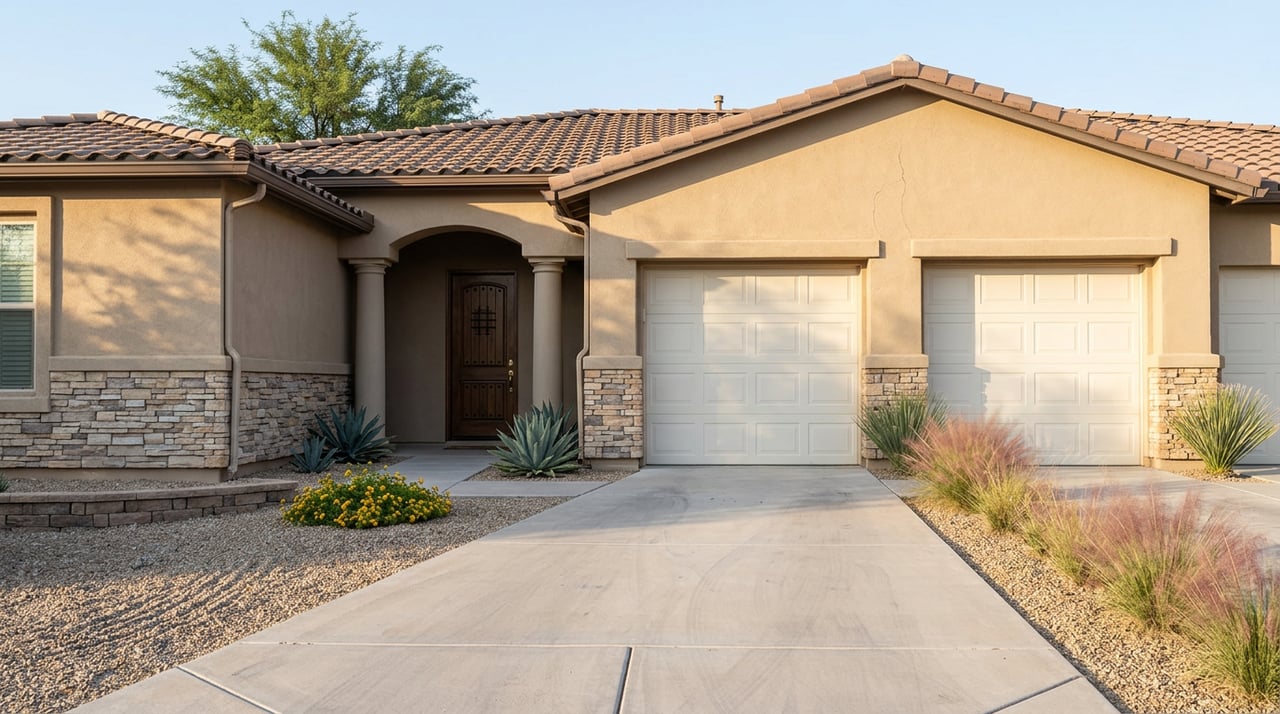
Two nearly identical homes go up for sale on the same street in Buckeye's Festival Ranch. Same builder, same floor plan, same year. One lists for $410,000. The other lists for $410,000 too. A buyer runs the numbers on both and assumes the monthly payment will land in the same place.
It won't. One of those homes carries a Community Facilities District assessment still being paid down on the property tax bill, a cost that can run $3,500 to $4,000 per lot, amortized over roughly 20 years. The other home's CFD balance was paid off years ago. Same list price, different real cost of ownership, and nothing on a listing portal tells you which is which until you or your agent pulls the tax record.
That gap is a small version of a much bigger story playing out across Buckeye right now. The headline numbers say the market is cooling. The investment happening around those same neighborhoods says the opposite. Both are true, and understanding why requires looking past the median.
What the median actually measures
Buckeye's median sale price sits around $400,000 as of June 2026, down roughly 2.3 percent from a year earlier. Homes are taking about 84 days to sell, up from around 67 days over the same period last year. Read on its own, that looks like buyers pulling back.
They aren't. Sales volume is actually up year over year. What's changed is who resale sellers are competing against. There are roughly 470 new-construction homes for sale in Buckeye right now, with a median listing price near $421,000 to $429,000, built by names like Meritage, D.R. Horton, David Weekley, Century Communities, and Lennar across master plans including Verrado, Sundance, Tartesso, and Teravalis, where the first village is on track to welcome residents later this year. A resale home priced to compete with those builders looks softer on paper even when the underlying appetite for living in Buckeye hasn't moved.
This is the part a portal search doesn't surface: a falling median in a builder-heavy market isn't proof that fewer people want to live there. It's proof that new supply is pricing against resale, and resale has to answer with something builders can't offer on day one.
The incentive that never shows up in the headline number
Builders in Buckeye are leaning on financing tools that don't appear anywhere in a listing price. A 3-2-1 rate buydown, where a buyer pays a rate three points below market in year one, two points below in year two, and one point below in year three before settling at the market rate, typically costs the builder 2.5 to 3.5 percent of the loan amount to fund. On a $480,000 home that's roughly $12,000 to $17,000 in value baked into a deal that a resale seller has no easy way to match. Stack in design-center upgrade credits and closing cost contributions, and builders are routinely offering $15,000 to $40,000 in effective value that a straight price comparison never captures.
That's not a knock on resale. It's the reason resale sellers in Buckeye need a different argument than price alone. A finished backyard beats a dirt lot. Installed blinds and shutters beat bare windows. A 30-day close beats a months-long build schedule in a neighborhood still running construction traffic. Those are real dollars and real time, they just don't show up in a headline comparison the way a builder's advertised base price does.
The part of the story the median can't see
While resale prices were softening through the first half of 2026, Buckeye was also landing some of the largest single investments in its history.
Tract acquired roughly 2,069 acres on Buckeye's west side in 2024 for what's being positioned as a 1.8-gigawatt data center campus near the Palo Verde nuclear plant and the I-10 corridor, with a possible buildout of up to 20 million square feet across as many as 40 individual buildings. A few miles away, JLL is now marketing Grand View Arizona, a 2,500-acre fully entitled industrial mega-site projected to generate more than $1 billion in economic impact as it fills with manufacturing and logistics tenants.
On the retail side, Vestar's $275 million Verrado Marketplace opened its first wave of tenants in May 2026, anchored by Target, Safeway, Ross, Marshalls, and HomeGoods, with Harkins BackLot's bowling-and-entertainment concept following in the fall. The 500,000-square-foot project is expected to generate more than 1,500 permanent jobs and over $50 million in tax revenue for the city.
None of that reads like a market losing confidence. It reads like a city building the employment and amenity base that supports housing demand for the next decade, even as this year's resale comps take a step back to absorb a wave of new-home supply.
What a $400,000 comp is actually pricing
The other reason Buckeye comps deserve a second look is that the city isn't one market. As of June 2026, three-bedroom homes are trading anywhere from roughly $345,000 to $445,000, with the median closer to $375,000, and production communities like Sienna Hills and Tartesso anchoring the lower end. Four-bedroom homes range from about $415,000 to $625,000, with Verrado resale routinely landing $410,000 to $475,000 for a three-bedroom, a premium over the citywide median that reflects the neighborhood's Main Street district and established landscaping rather than a different housing product entirely.
Layer a CFD on top of that and the comp gets more complicated. Buckeye has several active CFDs, including separate districts tied to Verrado, Sundance, and Festival Ranch, each levying its own rate that resets annually and appears on the county property tax bill rather than in HOA paperwork. The city maintains individual pages for each district for exactly this reason, because the assessment differs address to address even within the same subdivision.
Here's how that plays out in practice on two active-adult communities in Buckeye:
| Community | Base HOA | Additional layer | CFD or enhancement cost |
|---|---|---|---|
| Sun City Festival (Festival Ranch) | Roughly $540 per quarter | None, single association | CFD assessment of about $3,500 to $4,000 per lot, on the tax bill |
| Victory at Verrado | $112 per month | Verrado master fee of $146 per month | Community Enhancement Fee of 0.65 percent of price plus $500 at closing, about $3,750 on a $500,000 home |
Two buyers comparing these communities on HOA dues alone would miss the larger number sitting on the tax bill or due at closing. A lender underwrites those two homes differently even when a comp sheet treats them as interchangeable.
The developer petitions for a Community Facilities District early in a project's life, and the bonds are issued against the land. As the community sells through, responsibility for that debt shifts from the developer to whoever owns the home. A buyer stepping into a resale is stepping into that repayment mid-stream, which is exactly why the specific CFD balance matters more than the community's reputation for having one.
What this means if you're buying or selling in Buckeye right now
If you're selling, price to the current 84-day reality rather than a 2021 or 2022 comp, and lead with what a builder's spec sheet can't offer on day one: a finished yard, window coverings, and a neighborhood without active construction traffic. If you're buying new construction, ask for the builder's incentive menu in writing and run the total cost with and without the preferred lender, since that tradeoff often costs more over the life of the loan than it saves at closing. Either way, pull the CFD status on any specific Buckeye address before you anchor to a price. The city's interactive CFD map will tell you whether a parcel carries one, but it won't tell you the current balance or how it's been handled on past resales, which is a conversation worth having before you write an offer.
Frequently asked questions
How do I find out if a specific Buckeye home is in a CFD? The City of Buckeye maintains a CFD map for checking whether an address falls inside a district, and each district's assessment can also be confirmed on the Maricopa County property tax record, since it's billed separately from HOA dues.
Does a falling median mean now is a bad time to sell in Buckeye? Not on its own. Sales volume has increased year over year even as the median softened, which points to a market absorbing new construction supply rather than one where buyers have lost interest.
Is builder new construction actually cheaper than resale in Buckeye? Only if you compare the full picture. A builder's base price often understates the total by leaving out lot premiums, design center selections, and a finished backyard, all of which a comparable resale home may already include.
Who pays off a CFD balance when a home resells? It's negotiable and varies by transaction. Some sellers pay off the remaining balance before closing, others transfer it to the buyer, so it's worth confirming exactly where a specific home stands before an offer is written.
Buckeye's numbers this year reward the buyer or seller who reads past the headline, whether that's a median price that's telling a supply story instead of a demand story, or a tax bill carrying a cost the HOA paperwork never mentions. If you want a read on what a specific Buckeye address is actually pricing, or how a listing compares once builder incentives and CFD costs are factored in, Joseph Fear at Inspired Real Estate Life can walk through the numbers with you and build a plan around what they actually mean for your move.
